BaumEntscheid Header

BaumEntscheid Munich

More Trees for Munich

As Protect the Planet, we have been a key supporter of the BaumEntscheid Initiative from the very beginning—both financially and by contributing our experience and expertise from successful citizen-led initiatives such as the “Get Out of Coal” campaign.

Citizens’ initiatives are an important democratic tool for advancing social change and making concrete climate protection measures binding at the municipal level. The “BaumEntscheid” (Tree Decision) initiative impressively demonstrates how committed individuals can work together to develop solutions for a climate-resilient city.

What’s it all about?

Munich is getting hotter. On summer days, that’s why Munich residents are drawn to places where trees provide shade: along the Isar or in the English Garden.

But everyday life often takes place elsewhere—on streets and in public spaces that heat up significantly during the day and barely cool down at night. These heat islands are increasingly posing a threat to public health, the economy, and social inclusion in our city.

Munich performs very poorly in terms of green spaces when compared to other cities across Germany. In an analysis of the proportion of green space in major cities, it ranks only 74th out of 79.

At the same time, the number of trees has continued to decline: Between 2010 and 2019, Munich lost approximately 23,000 trees.

Trees are one of the most effective and, at the same time, most natural solutions to the climate crisis in cities. They make several key contributions:

  • Cooling and Heat Protection
    Trees lower the ambient temperature by about 2 °C through shade and evaporation. On a larger scale, they can cool entire neighborhoods by up to 4 °C—a significant difference during hot summers.
  • Clean Air
    Trees act as natural filters: they absorb fine dust and pollutants from the air, thereby noticeably improving air quality.
  • Water Storage
    Trees store rainwater, promote infiltration, and reduce the burden on the sewer system during heavy rainfall. In this way, they help prevent flooding and make the city more climate-resilient.
  • Biodiversity in the City
    City trees provide habitats for birds, insects, and other animals. They help preserve biodiversity even in urban areas.
  • Reduced cooling needs and energy savings
    By providing shade, trees cool buildings in the summer and reduce the energy required for air conditioning by about 30%. In the winter, they also provide protection from the wind and reduce heat loss.
  • Quieter Streets
    Rows of trees reduce street noise by scattering and absorbing sound waves. This can lower noise levels by about 2 to 8 decibels.

BaumEntscheid München advocates for more street trees and better protection against heat in the city. The goal is to establish a comprehensive network of street trees throughout Munich and to achieve at least 30% tree canopy cover on all municipal roads—especially in neighborhoods that experience particularly high temperatures.

The initiative is a response to the city’s increasing heat stress and the loss of thousands of street trees in recent years.

Three Goals for Munich:

  • Street Tree Network: 30% canopy cover along all municipal roads—with climate-resilient trees that are maintained on an ongoing basis.
  • Prioritize hot neighborhoods: We plant first in areas where it’s particularly hot, there’s a lack of shade, or where many seniors and families with children live.
  • Protecting Tree Habitats: Quick site selection for new trees—without encroaching on bike paths or sidewalks. From now on, infrastructure projects will make trees an integral part of their planning.


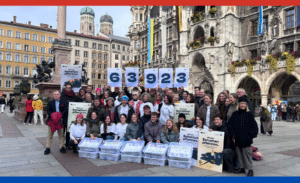
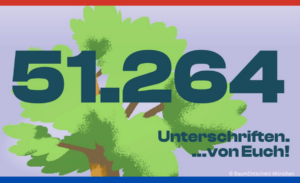
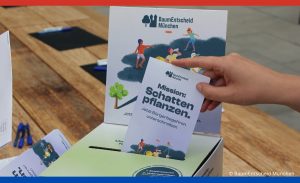
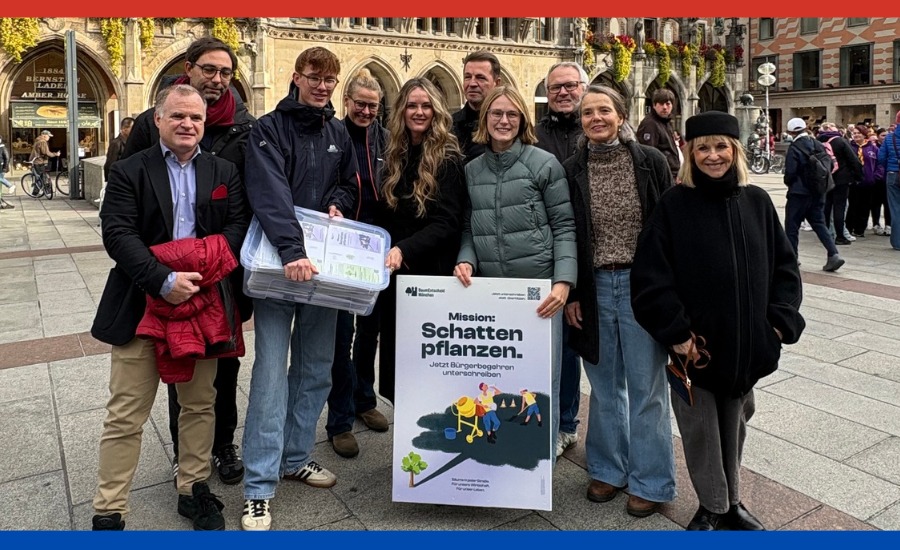
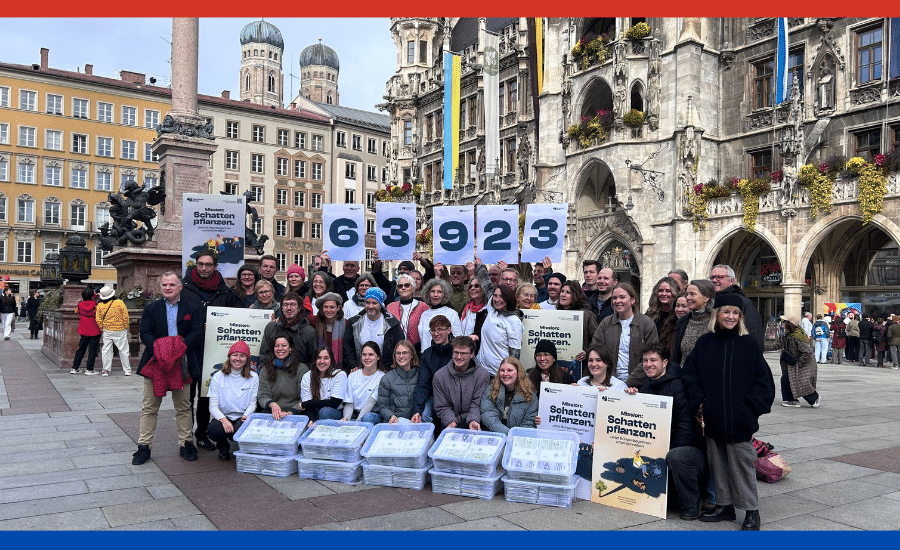
From May through August 2026, BaumEntscheid München, with the help of 50 partners and 150 volunteers, collected 63,923 signatures from Munich residents.

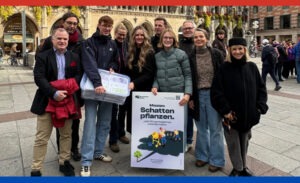
On October 23, 2026, the nearly 64,000 signatures that had been collected—almost twice as many as were needed—were handed over to city officials.

“BaumEntscheid München” Citizens’ Initiative

By signing this document, I request, in accordance with Article 18a of the Bavarian Municipal Code, that a referendum be held on the following question:

Do you support the City of Munich (City of Munich)

  • continuously and as a priority in urban planning policy pursue the following three objectives for expanding and improving the tree stock along municipal streets in order to improve the city’s environmental and quality of life in the long term, by:
  • creating a binding action plan for this purpose within one year of the citizens’ petition being accepted or of a successful citizens’ referendum being held, and
  • implementing these measures by 2040, including, where necessary, through structural modifications to municipal streets?

Objectives

Comprehensive street tree network

The City of Munich shall maintain a street tree network along municipal streets that, once the trees have reached maturity, achieves tree canopy coverage of at least 30% across the entire municipal street area. The street tree network shall consist of healthy, climate-resilient trees whose long-term preservation shall be ensured through active maintenance measures to sustain their vitality.

Greening and cooling particularly heat-stressed neighborhoods

The City of Munich shall define areas particularly affected by heat as “heat-stressed neighborhoods,” which shall be given the highest priority for action and in which the street tree network shall be expanded as a priority. The determination of heat-stressed neighborhoods shall be based on the City of Munich’s urban climate analysis as well as supplementary assessment criteria, in particular population density, an above-average proportion of vulnerable population groups (children aged 0 to 4 and people over 65), and the proportion of municipal streets with very low tree canopy coverage of less than 10%.

Creating new tree planting sites

Sufficient new tree planting sites for the municipal street tree network (see Objective 1) shall be identified and designated in planning by 2035. For heat-stressed neighborhoods, planning for new tree planting sites shall be completed by 2030. In doing so, areas used for pedestrian and bicycle traffic as well as public transportation shall generally remain unaffected. Areas for new tree planting sites shall be taken into account as comprehensively as possible in the planning and implementation of street and infrastructure measures, such as the restoration of street space and the construction or relocation of utility lines, and shall be integrated with these measures, for example as part of sustainable heat supply. Where street trees cannot be planted, equivalent green-blue infrastructure measures shall be implemented within a radius of 150 meters.

Rationale

Munich is becoming hotter in summer. Munich residents most often seek cooling where trees provide shade, for example along the Isar River. However, everyday routes often lead through bare streets that heat up strongly during the day and barely cool down at night. Whether young or old, heat endangers health and sleep, impairs economic productivity, and prevents social participation.

In our view, the City of Munich’s measures to date are not sufficient to adequately protect Munich’s residents from the increasing heat burden.

Therefore, the three objectives set out above shall be implemented: a comprehensive street tree network along municipal streets, the identification and prioritized greening of particularly heat-stressed neighborhoods, and the creation of new tree planting sites as part of a proactive climate adaptation strategy. In our view, these measures are beneficial for the development of the City of Munich because:

  • they preserve the quality of life and public spaces through shade and protect the health of the population through cooling;
  • early and systematic action preserves existing trees and creates new tree planting sites in time to provide sufficient cooling capacity;
  • street trees are durable, effective, and cost-efficient climate adaptation measures that make our neighborhoods more livable.

On November 9, 2026, the citizens’ initiative successfully reached an agreement with the city leadership on a permanent tree-planting program for Munich. The agreement is to be adopted by the full City Council on November 25, 2026. A citizens’ referendum will then no longer be necessary.

This is what was agreed:

  • Approximately 1,000 additional trees per year: Most will be newly planted, while some will replace felled trees.
  • Permanent budget for planting: From 2028 onward, the city will provide an additional 30 million euros per year for investments.
  • Permanent budget for materials and personnel: Starting in 2027, the city will provide 8.5 million euros for operating costs. The program has no time limit.
  • First where it is hottest: Priority will be given to highly sealed and heat-stressed neighborhoods. By the end of 2027, the city administration will develop an implementation plan based on the urban climate analysis and social data, for example identifying areas where particularly large numbers of young children and older people live.
  • Fewer tree removals at construction sites: In a “Construction Site Task Force,” Munich’s municipal utilities, wastewater department, and other companies that carry out extensive construction work in the street space will work with the Department of Urban Planning and Building Regulation to find solutions for planting trees above utility lines and sewers. Tree removals should be avoided wherever possible, and trees should be replanted.
  • Maintenance, not just planting: The parks and green spaces department will receive additional staff so that young trees can be maintained and survive hot summers. A citywide tree inventory has been commissioned.

Public funds are currently scarce. That makes this agreement all the more remarkable: it is a clear commitment to the people of Munich who are calling for more heat protection for the city, and a major step toward a city cooled by trees.

News articles on the BaumEntscheid:

Current events

Our series of informative events cover a broad range of issues on all aspects of the environment and nature preservation, climate crisis, energy and mobility trends and sustainable lifestyles.

Many different experts provide in-depth analysis of the burning questions of our time, as we explore how to live a climate-friendly life.

Missed an event?

News from the Planet